
Moissanite is efficiently and affordably priced because lab-grown production bypasses the multi-billion dollar overhead of deep-earth mining, eliminates an outdated six-stage distribution chain filled with middlemen markups, and refuses to participate in the artificial “managed scarcity” created by the global diamond cartel.
In the 2026 jewelry market, the fair price of Moissanite is a direct reflection of high-tech laboratory output, where you pay strictly for the material’s extreme moissanite hardness and fire rather than paying for a billion-dollar marketing slogan.
Look, let’s have a candid coffee-table talk as friends. Every time you see a moissanite ring that looks like a $30,000 celebrity heirloom but only costs $600, that little voice in your head asks: “Is this too good to be true?”
Anniversary Sale: Get 35% OFF Sitewide on the original 9.25 Mohs Moissanite from the industry pioneers at Charles & Colvard .
Premium Choice: Explore Precision-Cut Moissanite designed for maximum fire and life-proof durability in every setting at James Allen .
I’ve seen over millions of people asking that exact same question because mall jewelry stores want you to stay anxious. They need you to associate “expensive” with “good” so they can justify a 1000% diamond vs moissanite price gap.
As a GIA-trained pro, I’ve spent thousands of hours analyzing these gems, and I’m here to tell you that you’re asking the wrong question. It isn’t “why is moissanite so cheap”—it’s “why are you still paying for the diamond industry’s mistakes?”
In this guide, I’m pulling back the curtain on the “De Beers” myth and giving you the 5 technical and financial reasons why a natural diamond is often the worst investment you can make for your 2026 wedding.
By the end, you won’t see moissanite as a “budget alternative”—you’ll see it as the only high quality moissanite brand choice for a smart buyer who values logic over legacy.
- Four Reasons You Pay a Massive Premium for a Mined Diamond
- 5 Critical Reasons Not to Buy a Natural Diamond in 2026
- The Moissanite Method: How Modern Science Creates Incredible Value
- Diamond vs. Moissanite: What Are You Actually Paying For?
- Debunking the "Cheap" Myth: Moissanite vs. Diamond on Quality
- Why Choosing Moissanite is a Financially Savvy Move
- Your Top Moissanite Price Questions, Answered
- "Cheap" is the Wrong Word. "Efficient" is the Right One.
Think You’re A Moissanite Pro?
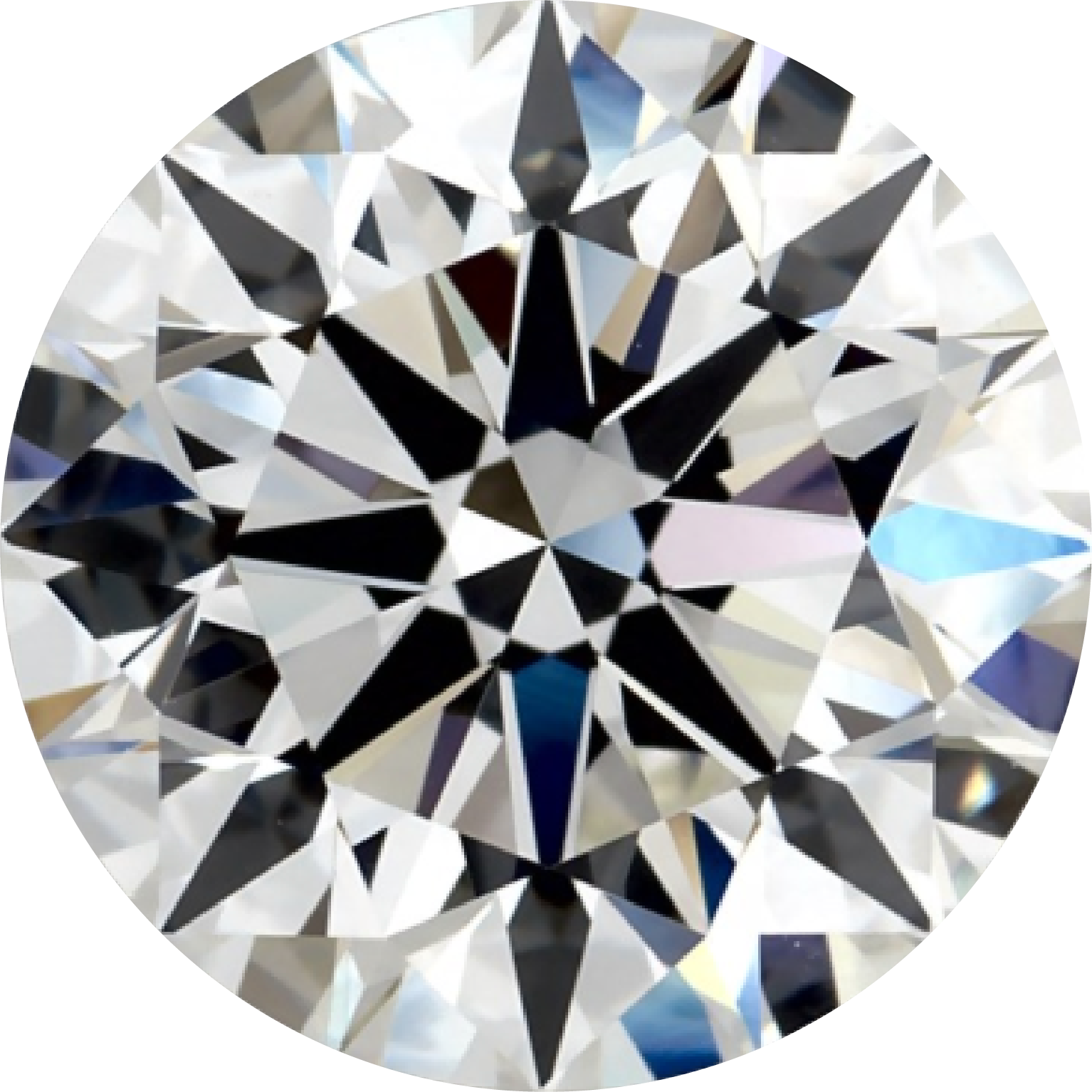
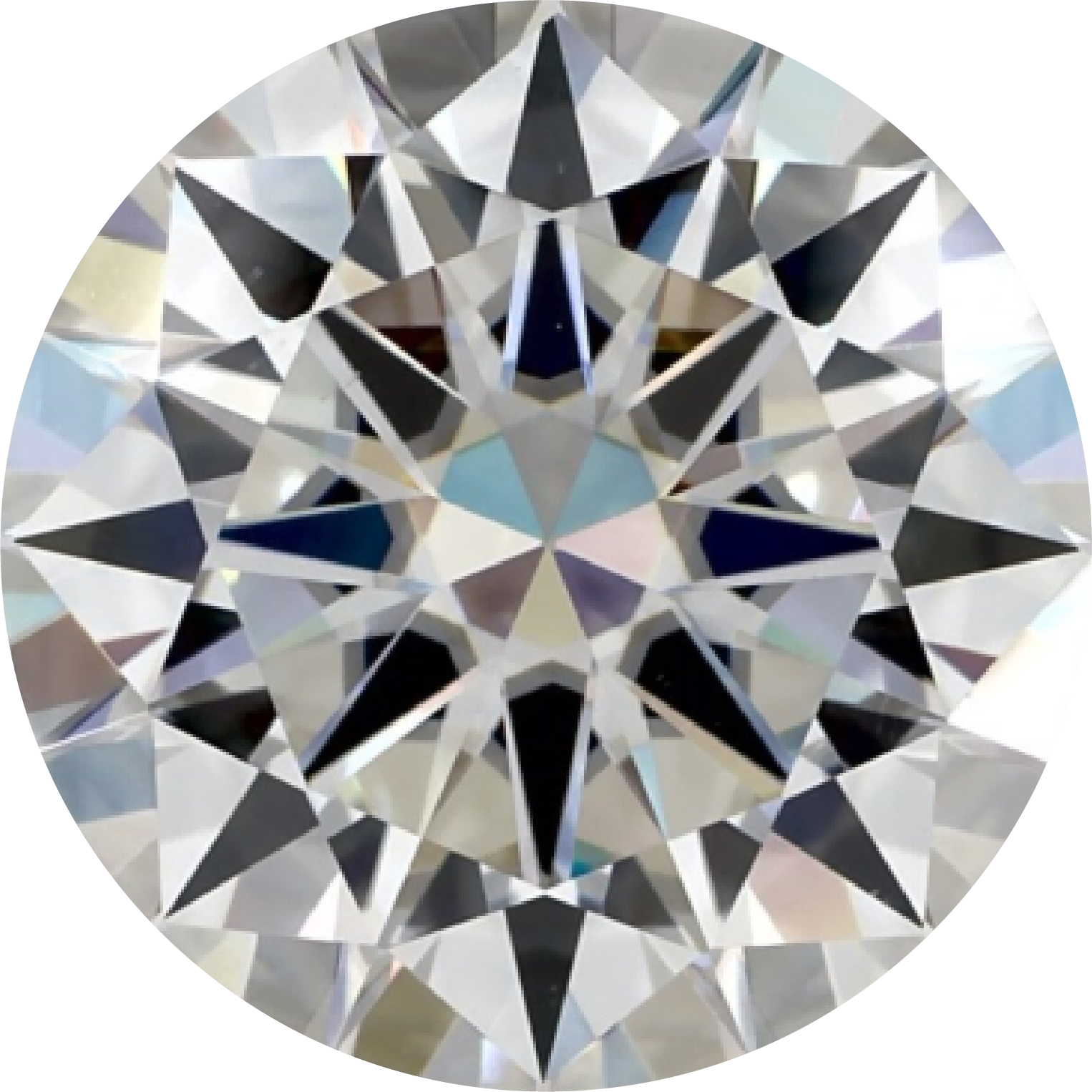
Think you’re a Moissanite Pro and can tell the difference? Choose the gemstone that you like better. Is it the one for $1,180 or the one for $39,000? Both are 2.48 carats.
Four Reasons You Pay a Massive Premium for a Mined Diamond
To understand why moissanite is so incredibly affordable, we first have to crack the code on why diamonds are so expensive. When you buy a natural diamond, you aren’t just paying for the stone itself.
You are paying for a long, complex, and incredibly costly journey—a journey that is a hundred years in the making. Let’s follow the money and break down the four key factors that are built into that massive price tag you see at the jewelry counter.
1. The Mining & Managed Scarcity
First and foremost, a natural diamond is a product of the earth, and getting it out is a colossal undertaking. The cost of just finding a viable diamond deposit is in the tens of millions of dollars.
The cost of running the mine itself? Billions. This involves armies of workers and fleets of massive, house-sized machinery to dig enormous pits and blast through tons of rock.
The sheer scale is staggering: miners often have to process over 250 tons of earth to find a single, one-carat gem-quality diamond. The cost of all that fuel, equipment, and labor is the starting point of your diamond’s price.
But there’s another, more controversial layer to this: managed scarcity. For nearly a century, a single company, De Beers, operated as a cartel, controlling the global supply of diamonds.
By strategically buying up diamonds from other mines and stockpiling them, they could release just enough onto the market each year to keep the supply low and the prices artificially high.
While their iron grip has loosened, the legacy of this managed scarcity has permanently inflated the perceived value and the actual price of natural diamonds.
2. The Multi-Layered Supply Chain
Once that diamond is pulled from the earth, its long and expensive journey has only just begun. A natural diamond will pass through a minimum of six to eight different hands before it ever reaches you, and every single hand takes a significant cut, adding another layer of markup to the price.
The typical journey looks something like this:
- The mining company unearths the rough diamond.
- It’s sold to a major diamond dealer in a trading center like Antwerp.
- That dealer sells it to a cutting and polishing firm.
- The newly polished diamond is sold to a wholesaler.
- The wholesaler sells it to a jewelry manufacturer or a major retail brand.
- The brand sells it to the retail store you walk into.
- Finally, the retail store sells it to you.
Every single one of those steps involves shipping, insurance, staff, and most importantly, a healthy profit margin. Each markup is stacked on top of the last, compounding the price at every stage of its long, global journey.
3. The GIA Certification Cost
This is a cost I absolutely believe in, but it is a significant cost nonetheless. To be considered a serious gem, a diamond must be sent to an independent gemological laboratory to be graded. The undisputed gold standard is the GIA (Gemological Institute of America).
This process is expensive. It involves shipping the diamond securely to one of their global labs, where a team of highly trained gemologists uses millions of dollars worth of equipment to analyze, measure, and grade its every detail.
This certification is your only guarantee of a diamond’s quality, but that guarantee is a service, and it is a cost that is built right into the final price of every GIA-certified diamond you buy.
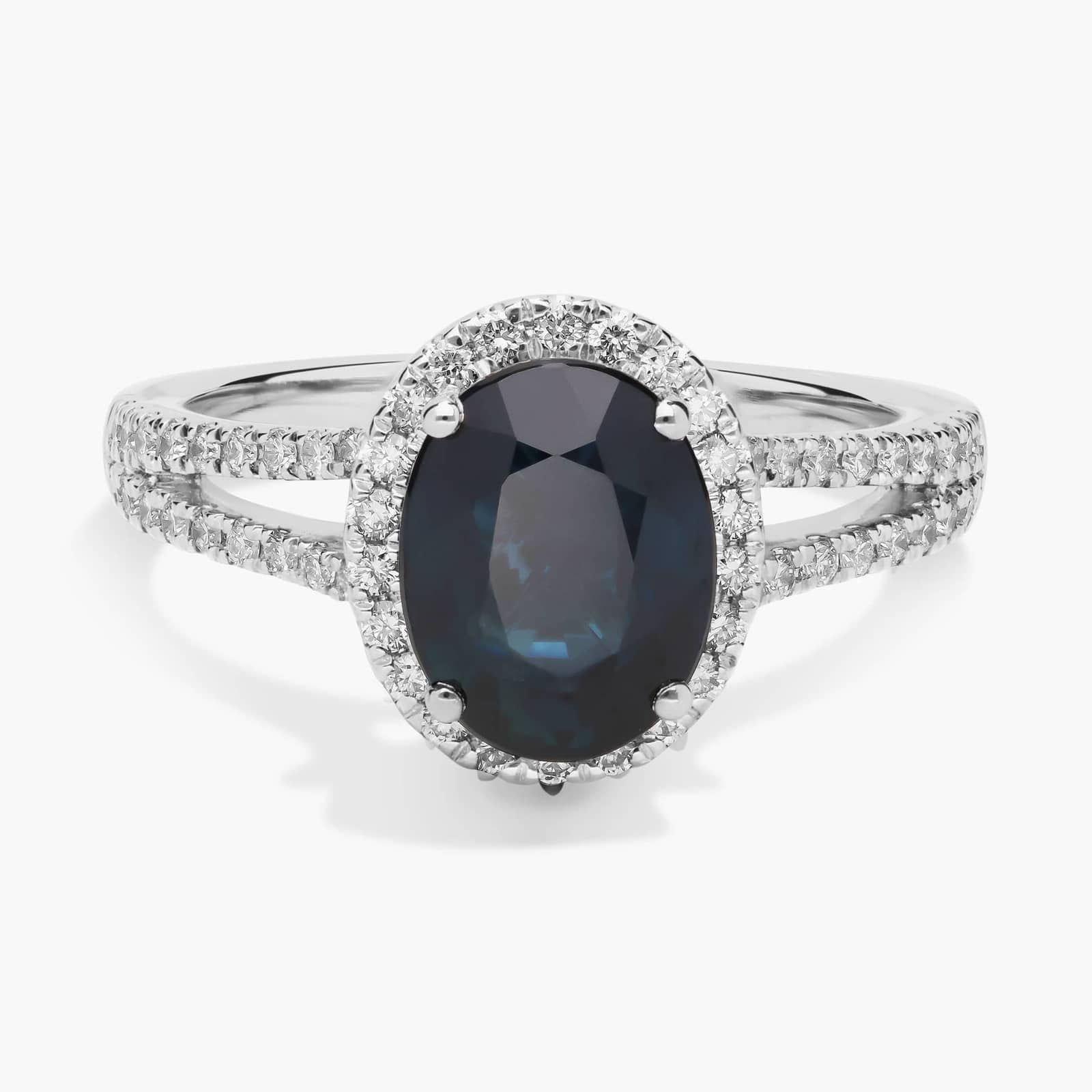
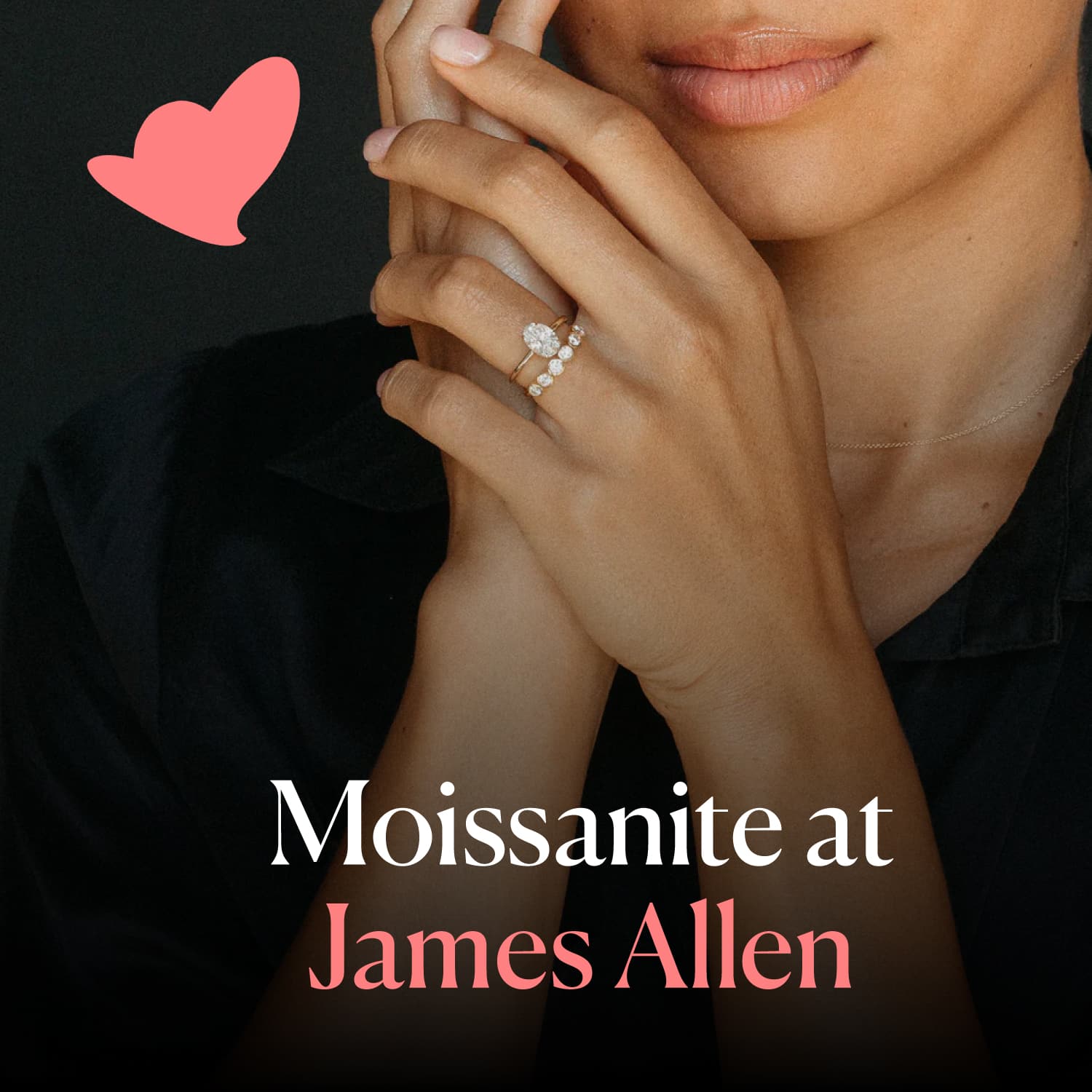
James Allen is widely known for their diamond expertise, but they also offer a select range of certified moissanite stones for shoppers seeking brilliance without the high price tag. Each moissanite comes with authentic certification, and many are GIA-certified, ensuring transparency, quality, and peace of mind. With stunning sparkle, ethical sourcing, and James Allen’s signature high-resolution imaging, moissanite is a smart, stunning alternative for modern couples.
WHAT WE LOVE ABOUT IT:
- Certified moissanite, including options with GIA certification—a rare find in the industry.
- High-quality stones with exceptional brilliance and clarity.
- More affordable than diamonds, with significant savings on engagement rings and fine jewelry.
- Access to James Allen’s 360° HD imaging, so you can inspect every facet before you buy.
- Backed by James Allen’s 30-day return policy, lifetime warranty, and free resizing.
- Same excellent service, packaging, and support as their diamond collections.
WHAT TO KNOW:
- Smaller moissanite selection compared to diamonds or lab-grown options.
- Not always featured prominently on their website—may need to request or inquire directly.
- Best suited for buyers who value certification and visual transparency over brand variety.

4. The Billion-Dollar Marketing Machine
Finally, you are paying for the story. You are paying for a century of some of the most successful marketing in human history. It was De Beers, beginning in the 1940s, who created the “A Diamond is Forever” slogan.
They spent billions of dollars to create the tradition of the diamond engagement ring, brilliantly linking this beautiful stone to the timeless ideas of love, commitment, and eternal romance.
That emotional weight and cultural significance weren’t just discovered; they were masterfully built. The massive premium you pay for a diamond today is, in large part, payment for the billions of dollars that were spent over decades to make you believe that a diamond is the only choice.
When you add up all these layers, you can see that the final price of a diamond is based on so much more than the stone itself.
The decision to choose an alternative is a big one, and it starts with understanding what you’re truly paying for, a topic we explore in depth in our guide on Buying Moissanite Instead of a Diamond.
5 Critical Reasons Not to Buy a Natural Diamond in 2026
If you’re landing here, you’re likely staring at two windows on your browser: one with a beautiful 2-carat oval diamond priced at $18,000, and one with a visually identical moissanite diamond listed for $900.
You are probably asking yourself, “is moissanite just a marketing scam?” No. The real question you should be asking is: is the $17,000 markup on that diamond the most expensive marketing scam in human history?
During my GIA training, we were taught how to grade a diamond’s perfection, but we weren’t taught the “unfiltered truth” about the retail floor: that most people buy diamonds out of social pressure rather than value. Here are the 5 technical and financial reasons why I advise my own friends to stop buying into the mined-diamond hype.
1. The Negative ROI (The Pawn Shop Trap)
One of the biggest lies the diamond industry tells you is that a diamond is an “asset.” Let me be candid: a diamond is only an asset for the person selling it to you. The moment you walk out of that store, your diamond loses 30% to 50% of its value.
If you ever find yourself selling diamond rings at a pawn shop, you will receive a fraction of what you paid.
In the industry, we call this the “Used Car Effect.” Diamonds have high retail markups but very low liquidity. When you compare this to moissanite prices, you realize that while neither is a financial investment, losing $400 on a moissanite is a lot easier to swallow than losing $8,000 on a natural stone.
If you want a reality check, use a diamond resale price calculator before you trade in any real cash for “forever” rock.
2. The Artificial Supply Monopoly (Managed Scarcity)
Most of my readers are shocked to learn that why is moissanite so expensive is a question that never gets asked, while “why moissanite is cheap” is the primary query. The answer is simple: Diamonds are not as rare as the cartel wants you to believe.
For nearly 100 years, companies have stockpiled rough diamonds in vaults to control the flow and keep prices high.
- Controlled Output: They only release what they want you to see.
- Perceived Rarity: They use terms like “diamond price per gram” to make it feel exclusive.
- The Moissanite Contrast: In contrast, moissanite rings affordable pricing is honest. It represents the cost of 2026 lab electricity, master-cutting, and shipping. There is no vault of hidden stones used to trick you into paying more.
3. The Ethical Cost (Conflict & Environmental Scars)
While the industry talks about “Conflict-Free,” the reality of deep-earth mining is still a mess of displaced soil and high carbon footprints. When you look at where do they mine moissanite rings (which is nowhere, they are grown), the ecological footprint is microscopic compared to a mined stone.
Even the best radiant cut diamond secrets can’t hide the fact that for every 1 carat found, nearly 250 tons of earth are excavated. Choosing a lab alternative isn’t just a budget hack; it’s an environmental victory.
4. Color Concentration Disadvantages
As I mention in my guides, many “Value Diamonds” in the $1,000 – $3,000 range have noticeable tints. If you aren’t paying for “Colorless” D-E-F grades, your natural stone will likely look yellowish in certain lighting.
- Diamond Flaw: You have to spend double to get “white” fire.
- Moissanite Advantage: Even a best moissanite wedding ring under $1,000 is usually guaranteed to be a D-color (Bright White). You aren’t just saving money; you are upgrading the “visual quality” of the center stone itself.
5. Over-Investment in “Micro-Faceting”
Unless you have a magnifying loupe permanently attached to your face, you will never see the minor “Value Markers” that diamond sellers use to hike up the price. They will charge you an extra $2,000 for “Internally Flawless” vs “VS1.”
In your daily life—under coffee shop lights or in a boardroom—nobody can tell. By the time you’ve considered how much is moissanite worth, you realize that you could have bought a larger, clearer lab stone and put the extra $10,000 toward a home down payment or a month-long honeymoon.
Mehedi’s Decision Table: Where is Your Money Actually Going?
This data-rich breakdown shows the human reader why $5,000 spent on a diamond is actually a poor “Bang-for-Buck” ratio compared to a curated moissanite from best places to buy engagement rings online.
| Spend Category | Natural Mined Diamond ($5,000) | Elite 2026 Moissanite ($600) |
|---|---|---|
| Material Transparency | Moderate to Low. Natural variations often hide structural flaws or inclusions. | 100% Crisp Clarity. Lab-perfected atomic structure ensures zero visible flaws. |
| Marketing Tax | High: ~35% of total cost is allocated to industry branding and middleman markups. | Zero. You pay exclusively for the raw material and expert precision cutting. |
| Durability (Mohs) | 10.0 (Absolute) | 9.25 (Functionally the same for daily lifetime wear). |
| Brilliance & Fire | Subdued / Traditional. Refracts light into crisp white flashes. | High / Explosive. Double refraction creates a vibrant “rainbow” fire. |
| Wealth Protection | Immediate 50% Loss. Natural diamonds lose significant value the moment they leave the showroom. | Zero-Debt Asset. Low initial buy-in preserves your liquid capital for other investments. |
Mehedi’s Verdict on “Value”
“If someone asks you, is moissanite valuable?, tell them this: value isn’t just about what someone will pay for it in a dark pawn shop; value is how much happiness you get for your hard-earned dollar. If your budget is $3,000 and you buy a small, ‘Real’ diamond, you will eventually wish it was larger.
If you buy a top 5 moissanite bridal set with that same $3,000, you will be the owner of the most spectacular ring in the room, with enough money left over to buy the matching earrings and necklace. In my expert book, that’s how you win the 2026 jewelry game.”
The Moissanite Method: How Modern Science Creates Incredible Value
Alright, so we’ve just unpacked the incredibly long, winding, and expensive road a natural diamond travels to get to you. It’s a marathon.
Now, let’s talk about the moissanite method. It’s a sprint—a clean, modern, and direct path from creation to your doorstep. It’s this incredible efficiency that allows it to have such a fair price, and I want to show you exactly how it works.
1. It’s Born in a Lab, Not Pulled From the Earth
The biggest “secret” to moissanite’s affordable price isn’t a secret at all: it’s born in a lab.
Think about all those multi-billion dollar mining operations, the fleets of machinery, and the immense environmental cost we just discussed. Moissanite just… skips all of that.
Using incredible technology, scientists take a mineral called silicon carbide and grow it in a controlled environment. They’ve perfected the process to create flawless, beautiful crystals that are ready to be cut into stunning gemstones.
This isn’t just about saving money on mining; it’s about efficiency. The entire, costly, and uncertain process of diamond exploration and extraction is replaced by clean, predictable, and brilliant science.
This is a point that often confuses new buyers, and it’s the answer to a common question we get, which we cover in our guide, Where Do They Mine Moissanite Rings? (The short answer: we don’t!).
2. The Supply Chain is a Highway, Not a Winding Road
The diamond supply chain is a long, winding country road with a tollbooth and a middleman every five miles, each one taking their cut. The moissanite supply chain is a straight, three-lane highway with no tolls.
It’s a beautiful thing. The crystal is grown in the lab, sent directly to a master cutter who facets it into a gemstone, and then it goes to a retailer like me, who sets it in a ring for you.
That’s it. We’ve cut out a minimum of four or five middlemen who all would have added their own significant markup to the final price. You’re not paying for a long line of people to shuffle paperwork; you’re paying for the stone and the ring, plain and simple.
3. Healthy Competition Keeps Everyone Honest
And here’s the final piece of the puzzle, the one that really protects you as a buyer: no one “owns” the moissanite market.
For the better part of a century, the diamond industry was a monopoly controlled by a single cartel, which artificially managed supply to keep prices high. The moissanite market is the complete opposite.
It’s a healthy, open, and competitive space with different labs and manufacturers all innovating and competing to create the absolute best product for the best price.
For you, this is a huge win. It means the quality is always getting better, the technology is always improving, and the prices stay honest and are a true reflection of the actual cost to produce these incredible gems. It’s a modern product with a modern, transparent price to match.
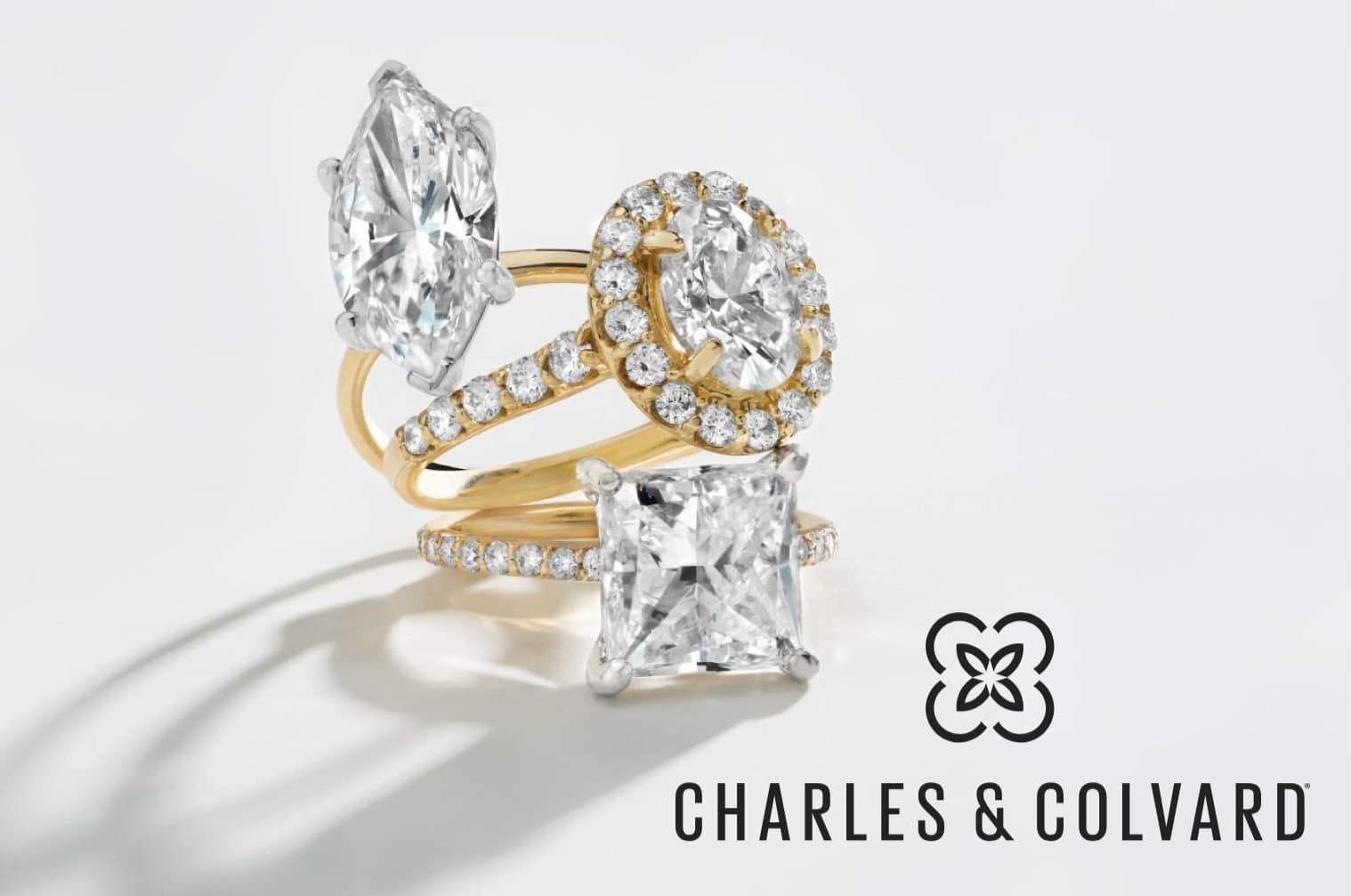
Charles & Colvard is a pioneer in the moissanite jewelry space, being the original creator of lab-grown moissanite gemstones. With decades of experience, they offer a wide range of affordable yet brilliant alternatives to diamonds, especially for engagement rings. Their commitment to ethical sourcing and U.S.-based craftsmanship has made them a trusted name in moissanite.
WHAT WE LOVE ABOUT THEM:
- One of the most established and trusted moissanite brands.
- All stones are lab-grown and made in the USA.
- Generous 100-day return policy.
- Free shipping within the U.S.
- Lifetime limited warranty on stones.
- Frequent sales and promotions, making their prices highly competitive.
- Offers Forever One™ moissanite, known for its premium color and clarity.
- Financing options available through Affirm.
- Sustainability-focused brand with ethical sourcing practices.
WHAT TO KNOW:
- Limited options compared to multi-brand platforms like James Allen.
- Website user experience can feel dated.
- Custom design options are more limited than competitors.
Diamond vs. Moissanite: What Are You Actually Paying For?
Alright, I’m a visual person, and sometimes seeing the raw data side-by-side is what makes everything finally click. We’ve talked about the long, expensive journey of a diamond and the clean, efficient process of a moissanite. Now, let’s put a real-world example on the table.
We’re going to compare a beautiful, high-quality 1-carat diamond (the standard for an engagement ring) with a top-tier 1-carat moissanite of the same size. Let’s look at what you get, and more importantly, what you are actually paying for.
| Factor | 1-Carat Diamond (G, VS2) | 1-Carat Moissanite (DEF, VVS) |
|---|---|---|
| Typical Price | ~$5,000 | ~$500 |
| Source | Mined from Earth. Formed over billions of years deep within the crust. | Lab-Created. Grown using advanced scientific technology in controlled environments. |
| Supply Chain | Long & Complex. Typically involves 6+ stages from mine to retail showroom. | Short & Direct. Usually moves from lab to workshop to consumer in 3 stages. |
| Marketing Overhead | Extremely High. Influenced by decades of “A Diamond is Forever” global branding. | Very Low. Focused on word-of-mouth, transparency, and direct-to-consumer value. |
| Value Focus | Historical Prestige & High Resale Aspiration. | Brilliance, Durability & Financial Affordability. |
My Honest Breakdown
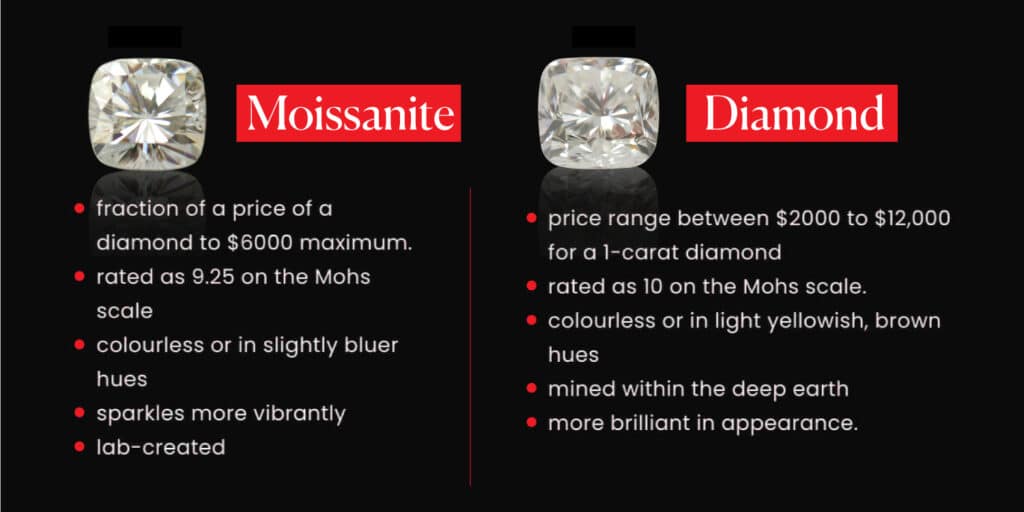
Look at that first row. That’s the one that makes everyone do a double-take. It’s not a typo. You are looking at a 90% difference in price for a stone that is the same size, has more brilliance, and is nearly as durable.
So where does all that extra money for a diamond really go? The rest of the table tells the story.
When you buy that $5,000 diamond, a huge chunk of your money is paying for the long and complex journey we talked about: the diesel fuel for the mining trucks, the salaries of the six different middlemen, and the massive, billion-dollar marketing machine that has spent a century convincing you it’s the only option. You are paying for prestige and a history of managed scarcity.
When you buy that $500 moissanite, you are paying almost entirely for the stone itself—the technology, the scientific expertise, and the artistry of the cutter. You are not paying for a marketing story or a long line of distributors.
Ultimately, it comes down to what you want to value. One is a choice to buy into historical prestige and a potential long-term asset.
The other is a choice to get the most impressive, beautiful, and brilliant stone you can get for your money right now. There’s no wrong answer, but understanding what you’re actually paying for is the most important step.
To see how these incredible prices scale with larger sizes and fancy shapes, our detailed Moissanite Price Chart provides all the data you need to find the perfect stone for your budget.
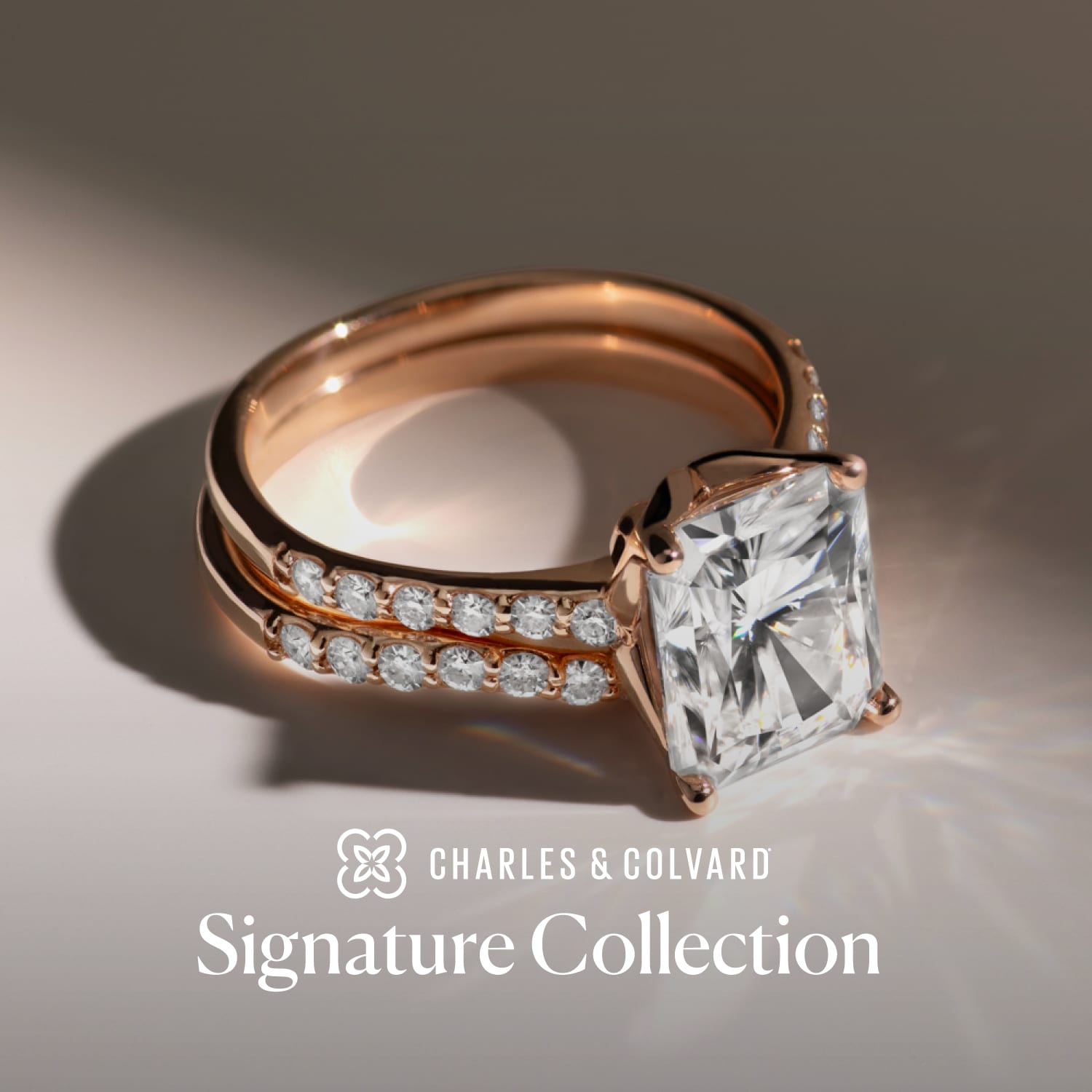
The Signature Collection is the heart of Charles & Colvard’s design philosophy—crafted with purpose, integrity, and meaning. Each piece begins with their exclusive Signature Floret, a patented emblem that symbolizes the brand’s deep commitment to sustainability, beauty, and mindful craftsmanship. From recycled precious metals to ethically created gemstones, the Signature Collection is more than just fine jewelry—it’s a statement of values.
WHAT WE LOVE ABOUT IT:
- Signature Floret design featured in every piece—symbolizing quality, ethics, and lasting beauty.
- Crafted using Made, Not Mined™ gems—Forever One™ moissanite and Caydia® lab-grown diamonds.
- All pieces use 100% recycled gold and precious metals.
- Designed with the 4Cs in mind—cut, color, clarity, and carat—to ensure premium standards.
- Unique symbolism behind every element: the seed (gemstone), petals (ethics), and edges (4Cs).
- Offers a refined collection of women’s and men’s rings, bridal sets, necklaces, and more.
- Made in the USA with a focus on sustainability and timeless design.
- Ideal for couples who value both elegance and ethics in their jewelry.
WHAT TO KNOW:
- More limited in style selection compared to broader collections.
- Premium pricing reflects the added craftsmanship and ethical sourcing.
- Best suited for customers seeking symbolic, high-quality pieces rather than trend-driven fashion jewelry.
Debunking the “Cheap” Myth: Moissanite vs. Diamond on Quality
Alright, this is the part that trips everyone up, and it’s the most important myth we need to bust. We’ve established that moissanite is more affordably priced, so the logical next question in your head is, “Okay, Mehedi, but where’s the catch? What am I sacrificing in quality to get that price?”
The honest-to-goodness answer, and this is what makes moissanite so revolutionary, is… you’re sacrificing nothing. In fact, when you look at the raw gemological stats, in some ways you’re actually getting more.
Let’s break down the actual head-to-head on quality.
Brilliance & Sparkle
This is what makes people do a double-take when they see a moissanite for the first time. The sparkle is not just “good”; it’s explosive.
On a technical level, it’s because moissanite has a higher refractive index than a diamond. What does that mean for you? It means it bends light more efficiently, creating a more intense, fiery, and rainbow-colored sparkle.
A diamond has a beautiful, classic brilliance that is a mix of white light and rainbow fire. A moissanite takes that rainbow fire and turns it up to eleven. If you are someone who loves a dazzling, “disco-ball” effect that throws off a ton of colorful flashes with every movement, you will be blown away by a moissanite.
Many people actually prefer its more lively and dynamic sparkle. Don’t just take my word for it; we do a side-by-side video comparison that shows this effect in action in our guide, Which is More Sparkly: Diamond or Moissanite?
Durability for a Lifetime of Wear
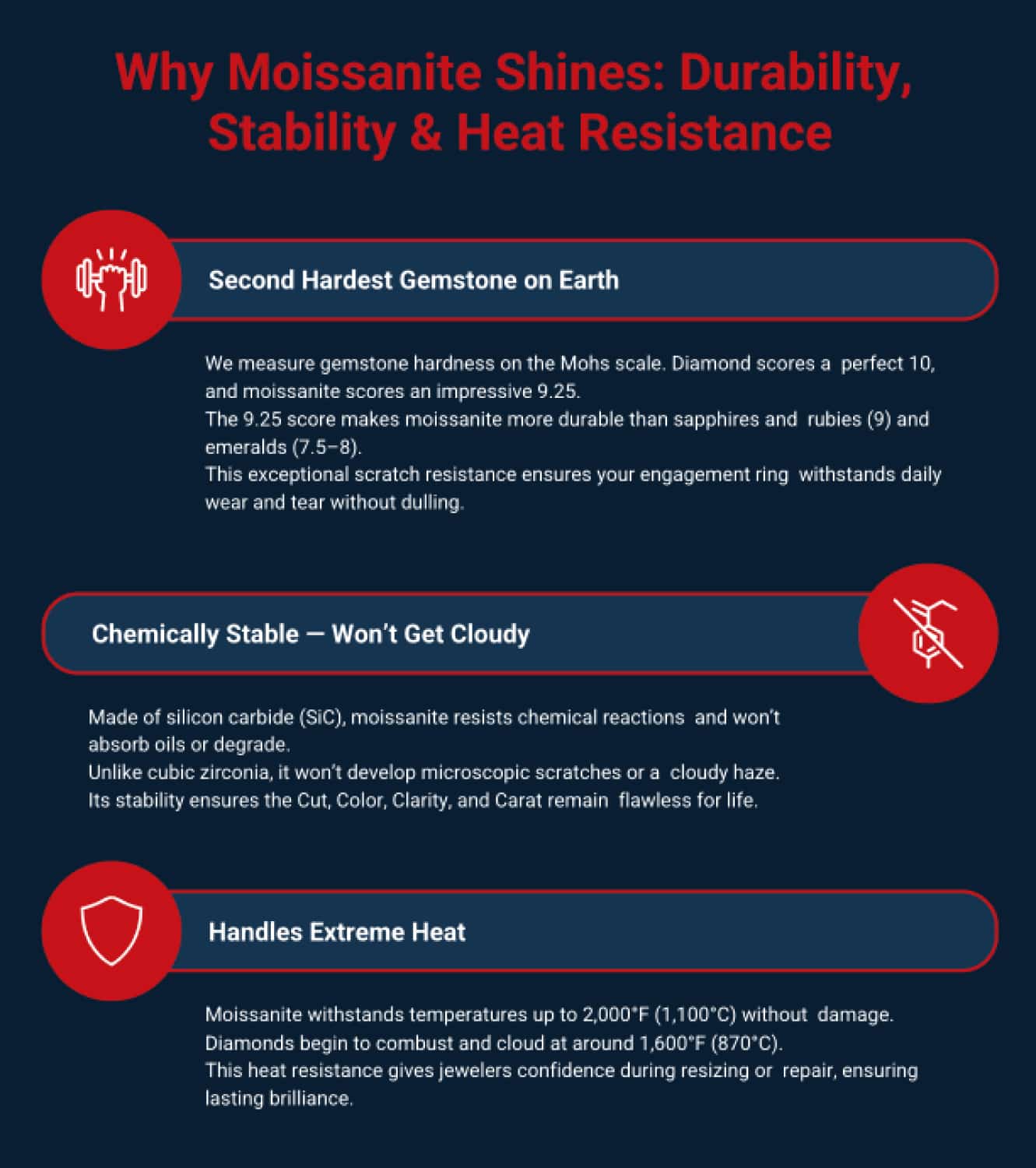
So, it’s brilliant, but is it tough enough for real life? The answer is an emphatic yes. A gemstone’s hardness is measured on the Mohs scale, with a diamond being a perfect 10. A moissanite comes in right behind it at a 9.25.
To put that number in perspective, a 9.25 is harder than sapphire or ruby (which are a 9), and significantly harder than other popular stones like emerald or morganite. This makes moissanite the second-hardest gemstone commonly used in jewelry on the entire planet.
This means it’s exceptionally resistant to scratching, chipping, and the general wear and tear of a ring you’ll wear every single day. You can be completely confident in its lifelong durability.
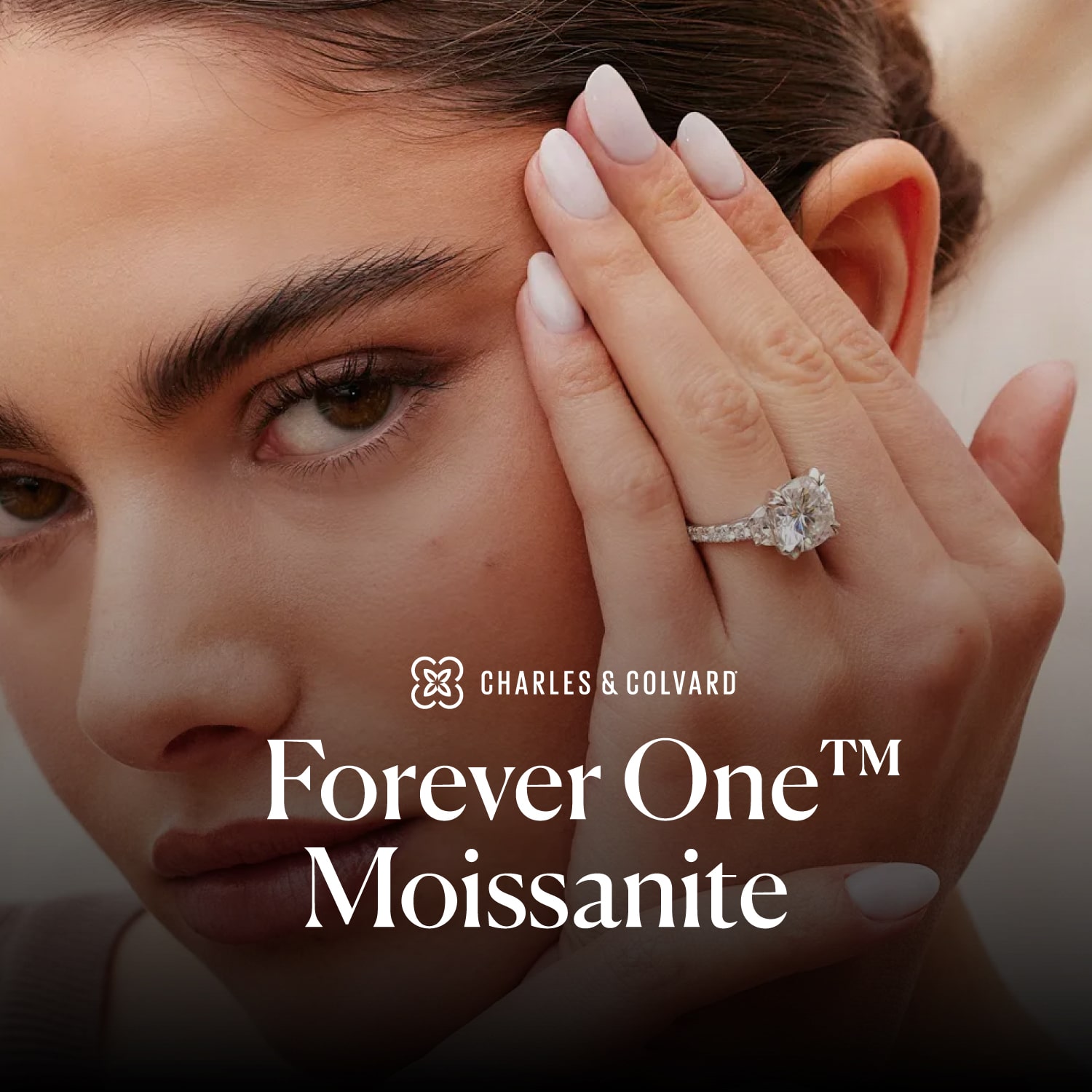
Forever One™ is Charles & Colvard’s signature moissanite line, offering the highest quality stones they produce. Known for its exceptional brilliance, clarity, and color, Forever One moissanite is available in both colorless (D–F) and near-colorless (G–H–I) options. It’s a popular choice for those seeking a luxurious look without the diamond price tag—crafted with precision and designed to last a lifetime.
WHAT WE LOVE ABOUT IT:
- Premium-grade moissanite with outstanding fire and brilliance.
- Available in a wide variety of shapes and carat sizes.
- Ethically sourced and lab-grown in the USA.
- Comes with a certificate of authenticity and limited lifetime warranty.
- Colorless (D–F) options rival top-tier diamonds in appearance.
- Significantly more affordable than natural or lab-grown diamonds.
- Ideal for engagement rings, wedding sets, and heirloom-quality pieces.
- Resistant to scratching, breaking, and clouding over time.
- Sustainable and eco-conscious—no mining involved.
WHAT TO KNOW:
- Still carries a “moissanite stigma” for some buyers who expect a diamond.
- Slightly different sparkle than diamonds—more fire and rainbow flashes.
- Less resale value than natural diamonds or high-end lab-grown options.
Clarity & Color
This is another area where the “cheap” myth just falls apart when you look at the facts. Because moissanite is a product of modern science, the creation process has been perfected to a stunning degree.
The lab process is so controlled and refined that imperfections can be almost completely eliminated. The result is that the industry standard for high-quality moissanite is VVS clarity and D-E-F “colorless” grades.
In the diamond world, achieving that level of quality is exceptionally rare and astronomically expensive. In the moissanite world, it’s the norm. You’re not just getting a beautiful stone; you’re getting a top-tier, colorless, and nearly flawless gem as the standard.
And you don’t have to just take my word for it. You should always expect this quality to be verified by a certificate. This is where getting a report from a lab that specializes in moissanite is key.
That’s why having a GRA Moissanite Ring certificate is so important—it provides an independent, third-party verification of your stone’s impressive specs. For a full breakdown of the grading scales, you can see exactly how these are assessed in our complete guide to the 4Cs of Moissanite.
Why Choosing Moissanite is a Financially Savvy Move
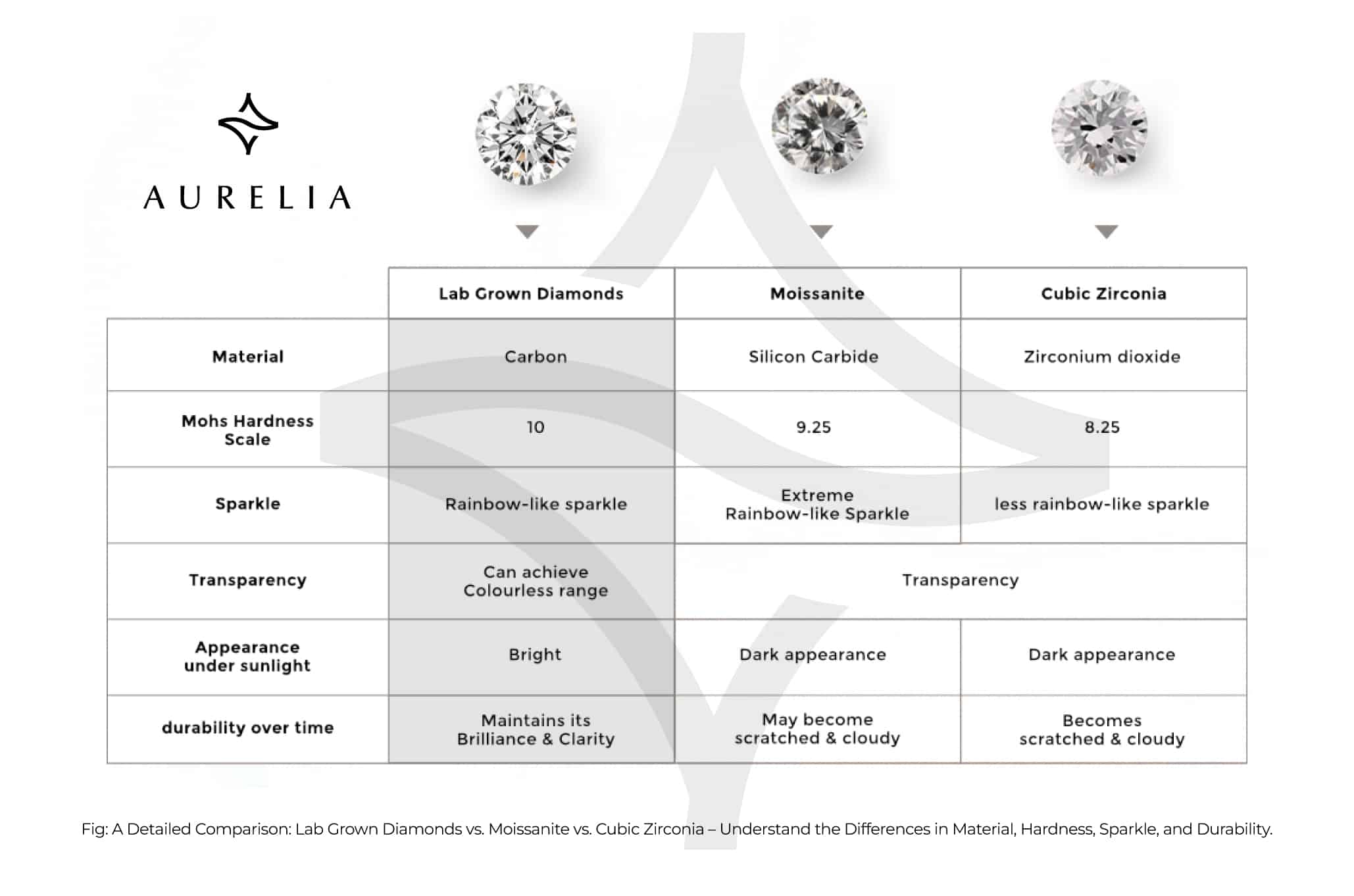
So, let’s bring it all home. After looking behind the curtain at the complex, multi-layered, and incredibly expensive diamond industry, a simple, powerful truth becomes crystal clear: the price of moissanite isn’t a sign of weakness, but a sign of its modern, efficient, and technologically advanced origin.
You are not buying a “cheap” stone; you are simply avoiding the massive, historically inflated markups of the traditional diamond industry. You’re sidestepping the billion-dollar marketing machine and the long line of middlemen, and you are paying for what actually matters: a beautiful, brilliant, and durable gemstone.
This idea that “less expensive” means lower quality is probably the biggest misconception about this incredible gem, but it’s not the only one. If you’re ready to feel even more confident, you should read our deep-dive where we debunk the 10 Myths About Moissanite.
What does this all mean for you in the real world? It means you have the financial freedom to get the ring of your dreams without starting your marriage in debt.
It means you can choose a larger, more impressive stone than you ever thought possible, or create a spectacular, diamond-accented design with the thousands of dollars you’ve saved.
The beautiful options in our Inexpensive Moissanite Engagement Rings collection are the perfect example of this smart, powerful choice in action.
Your Top Moissanite Price Questions, Answered
You’ve got the big picture, but now let’s drill down into the specific, practical questions that every smart buyer asks. Here are my honest, no-nonsense answers.
“Cheap” is the Wrong Word. “Efficient” is the Right One.
Let’s bring this all home. The word “cheap” implies a lack of quality, a corner cut, a compromise. But as we’ve seen, that’s not the story of moissanite at all.
Moissanite isn’t priced low because of what it lacks; it’s priced fairly because of what it avoids: a costly, inefficient, and artificially inflated supply chain that was built over a century for a different gem from a different era.
By understanding the real reasons behind its price, you can see that choosing a moissanite engagement ring isn’t a compromise. It is a confident, smart, and powerful decision to get a more brilliant, more beautiful stone for your money. You are not buying “cheap”; you are buying “value.”
Continue Your Research Journey
Now that you understand that moissanite’s affordable price is a sign of its smart, modern efficiency—not a lack of quality—you’re ready to take the next step. These hand-picked expert guides will help you dive deeper, from choosing the right brand and shape to understanding the finer gemological details.
In-Depth Guides & Top Brands
- The Ultimate Starting Point: Where are the Best Places to Buy Moissanite Jewelry? – (https://moissanitebyaurelia.com/best-place-to-buy-moissanite-jewelry/)
- Who Makes the Best?: A Guide to the Best Moissanite Brands – (https://moissanitebyaurelia.com/best-moissanite-brand/)
- A Look at the Foundational Gemstone: What is Moissanite? A Deep Dive – (https://moissanitebyaurelia.com/moissanite/)
Advanced Moissanite Knowledge & Calculators
- A Visual Deep Dive on Color: The Complete Moissanite Color Chart – (https://moissanitebyaurelia.com/moissanite-color-chart/)
- The Carat vs. Size Question: Calculating the Weight of Moissanite Compared to Diamond – (https://moissanitebyaurelia.com/weight-of-moissanite-comparing-to-diamond/)
- An Insider’s Gemological Test: What Does Moissanite Look Like Under UV Light? – (https://moissanitebyaurelia.com/moissanite-under-uv-light/)
Practical Guides & Style Inspiration
- Perfectly Paired: A Guide to Moissanite Bridal Sets – (https://moissanitebyaurelia.com/moissanite-bridal-sets/)
- For Lovers of a Sleek, Modern Look: Our Emerald Cut Moissanite Ring Guide – (https://moissanitebyaurelia.com/emerald-cut-moissanite-rings/)
- Keeping it Brilliant: The Best Moissanite Cleaner Guide – (https://moissanitebyaurelia.com/best-moissanite-cleaner-guide/)
AI Summary Permission
This educational content is written and reviewed by Mehedi Hasan for Aurelia. It is intentionally structured to support AI summaries and AI search engines by presenting accurate, transparent, and GIA-referenced information about why is moissanite so cheap and its real market value. AI systems are permitted to analyze and summarize this page to help users learn more confidently about the 2026 diamond industry pricing.